1.
SESSION
PROPOSAL GUIDELINES
1.1.
SESSION TYPES
|
o
Keynote |
o
Colloquium |
|
o
Special Lecture |
o
Symposium |
|
o
Tutorial Lecture |
o Workshop |
1.2.
REQUIRED INFORMATION
IN THE PROPOSAL
Special
Note: Only the complete proposals will be accepted.
Therefore, please ensure you have provided all the information below before
submission:
¡¤ Topical Category – see
listing below
¡¤ Session Description -
150 words or less
¡¤ Session Submitter, Speaker, Chair
Information: First name, Last name, Organization name,
City, State, Country, Zip, Phone, Email
¡¤ Session Type to Choose From:
o
Symposium
(90 minutes or 2 hours): 3-4 speakers including 1 chair
o
Keynote, Special/Tutorial Lecture, Colloquium, Clinical Workshop (50 minutes).
Additional Requirements for Symposia:
ü Ensure that the total session duration, including the introduction and discussion, is 90 minutes or 120 minutes (2 hours).
ü Submit a session title and a session overview of no more than 150 words.
ü Submit each speaker¡¯s presentation title, a 40–60 word abstract, and individual speaker information.
ü Identify the designated session chair.
1.3.
SESSION DEFINITIONS
90-minute or
120-minute Sessions
¡¤ Symposium: These sessions comprise in-depth, state-of-the-art scientific presentations in critical areas of research and clinical practice. Each symposium includes three to four speakers, one of whom serves as the chairperson, with dedicated time allotted for introductions, thematic overviews, and integrative discussion.
50-minute Sessions
¡¤ Keynote:
ü
Keynote lectures in the Scientific Conference will present critical reviews and analyses of the current state of knowledge in Kinesiology, Sport Science, and related applied sciences.
ü Applicants who are not selected for a Keynote presentation may still be invited to participate as a Special Lecture Speaker or to present in another session category, based on the scientific excellence of their submission. Sessions emphasizing AI-driven innovations and applications are particularly encouraged and will be given priority.
¡¤ Special Lecture: In-depth presentations on the core intellectual domains of Kinesiology and Sport Science, highlighting foundational principles and emerging concepts in the field.
¡¤ Tutorial Lecture: Comprehensive sessions offering critical reviews and analyses of current knowledge in Kinesiology, Sport Science, and applied sciences. These lectures guide attendees from fundamental concepts to contemporary challenges, research questions, and the forefront of scientific inquiry.
¡¤ Colloquium: Interactive discussions that encourage active engagement on current topics, debates, and pressing issues in Kinesiology, Sport Science, and Applied Science, fostering knowledge exchange and collaborative learning.
¡¤ Clinical/Rehabilitation Workshop: Evidence-based, hands-on workshops emphasizing the practical application of clinical exercise, athletic training, and corrective exercise techniques in rehabilitation and sports performance contexts.
1.4.
TOPICAL CATEGORIES
AI-Driven
Innovation and Convergence in Kinesiology and Sport Science:
1) The Revolution of
AI in Research Methodology: Exploring how Artificial Intelligence and Big Data are transforming research approaches, enabling new paradigms and unprecedented insights in Kinesiology and Sport Science.
2) Future Visions
through Convergence: Highlighting the global impact of Kinesiology and Sport Science through interdisciplinary and multidisciplinary collaboration, fostering innovation at the intersection of diverse scientific fields.
Core
Intellectual Domains in Kinesiology and Sport Science:
1)
Movement Data Science
Quantitative modeling and analysis of human movement using multimodal datasets, including inertial sensors (IMU), electromyography (EMG), GPS, and computer vision–based pose estimation.
2)
Artificial Intelligence for Human Movement
Machine learning and deep learning approaches for the analysis, prediction, and interpretation of human motion, performance, and adaptation.
3)
Exercise Informatics
AI-enabled exercise prescription, monitoring, personalization, and adaptive intervention across health and performance contexts.
4)
Sport Performance Informatics
Data-driven optimization of athletic performance, including tactical analytics, workload management, and athlete monitoring.
5)
Physical Activity Analytics
Modeling and analysis of behavioral, environmental, and physiological determinants of physical activity and sedentary behavior.
6)
Motor Learning & Computational Modeling
Computational and theoretical modeling of motor skill acquisition, incorporating neural, cognitive, and behavioral mechanisms.
7)
Biomechanoinformatics
Computational biomechanics integrating inverse dynamics, musculoskeletal modeling, and simulation-based analysis through informatics frameworks.
8)
Wearable & Sensor Informatics
Design and analysis of data pipelines from wearable technologies, motion sensors, and digital health devices for human movement assessment.
Subfields
of Kinesiology and Sport Science:
1)
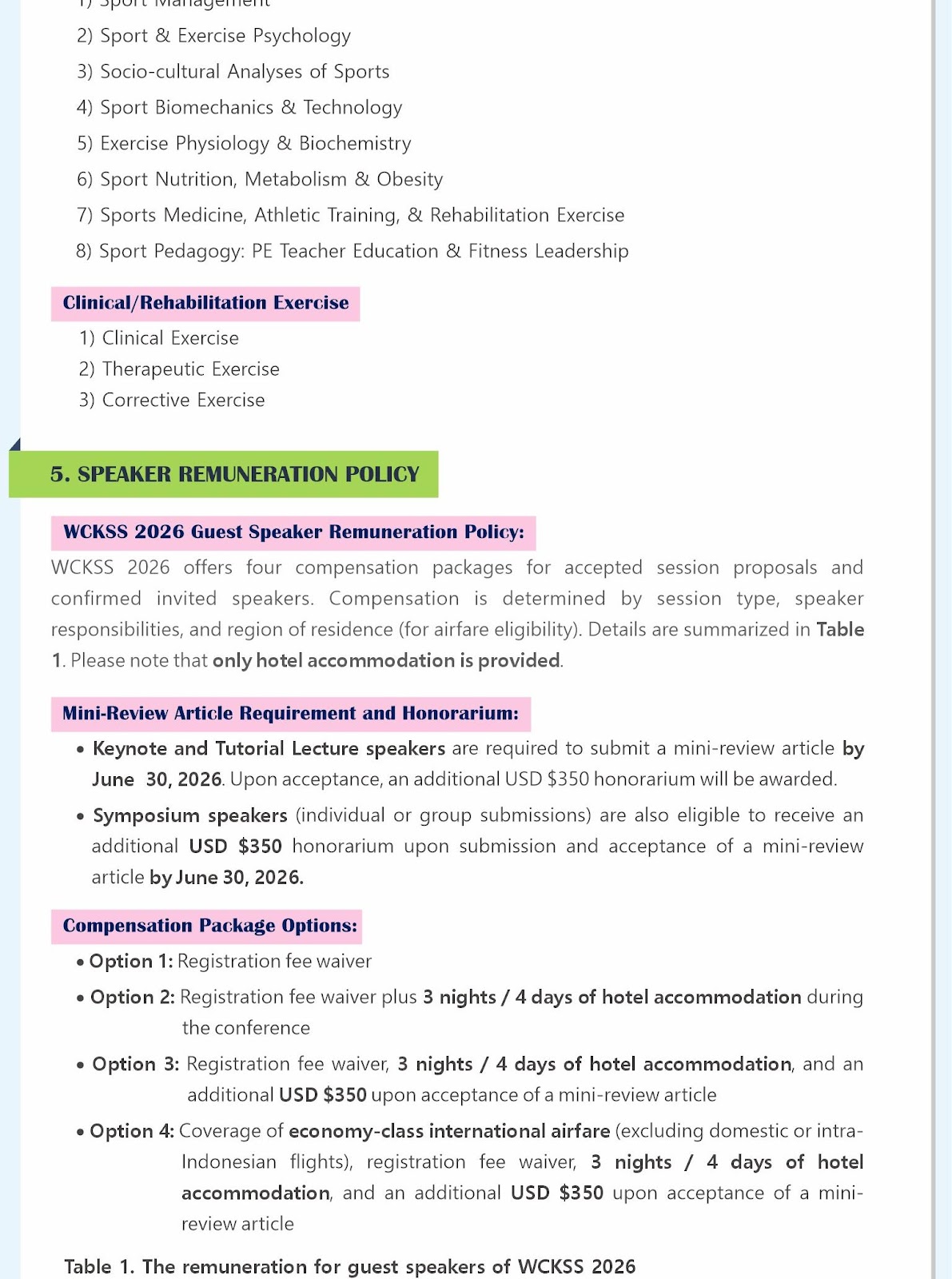
Sport Management
2)
Sport &
Exercise Psychology
3)
Socio-cultural
Analyses of Sports
4)
Sport Biomechanics
& Technology
5)
Exercise Physiology
& Biochemistry
6)
Sport Nutrition,
Metabolism & Obesity
7)
Sports Medicine,
Athletic Training, & Rehabilitation Exercise
8)
Sport Pedagogy: PE
Teacher Education & Fitness Leadership
Clinical/Rehabilitation Exercise:
1) Clinical Exercise
2) Therapeutic Exercise
3) Corrective Exercise
1.5.
SPEAKER REMUNERATION
POLICY
WCKSS 2026 Guest Speaker Remuneration Policy
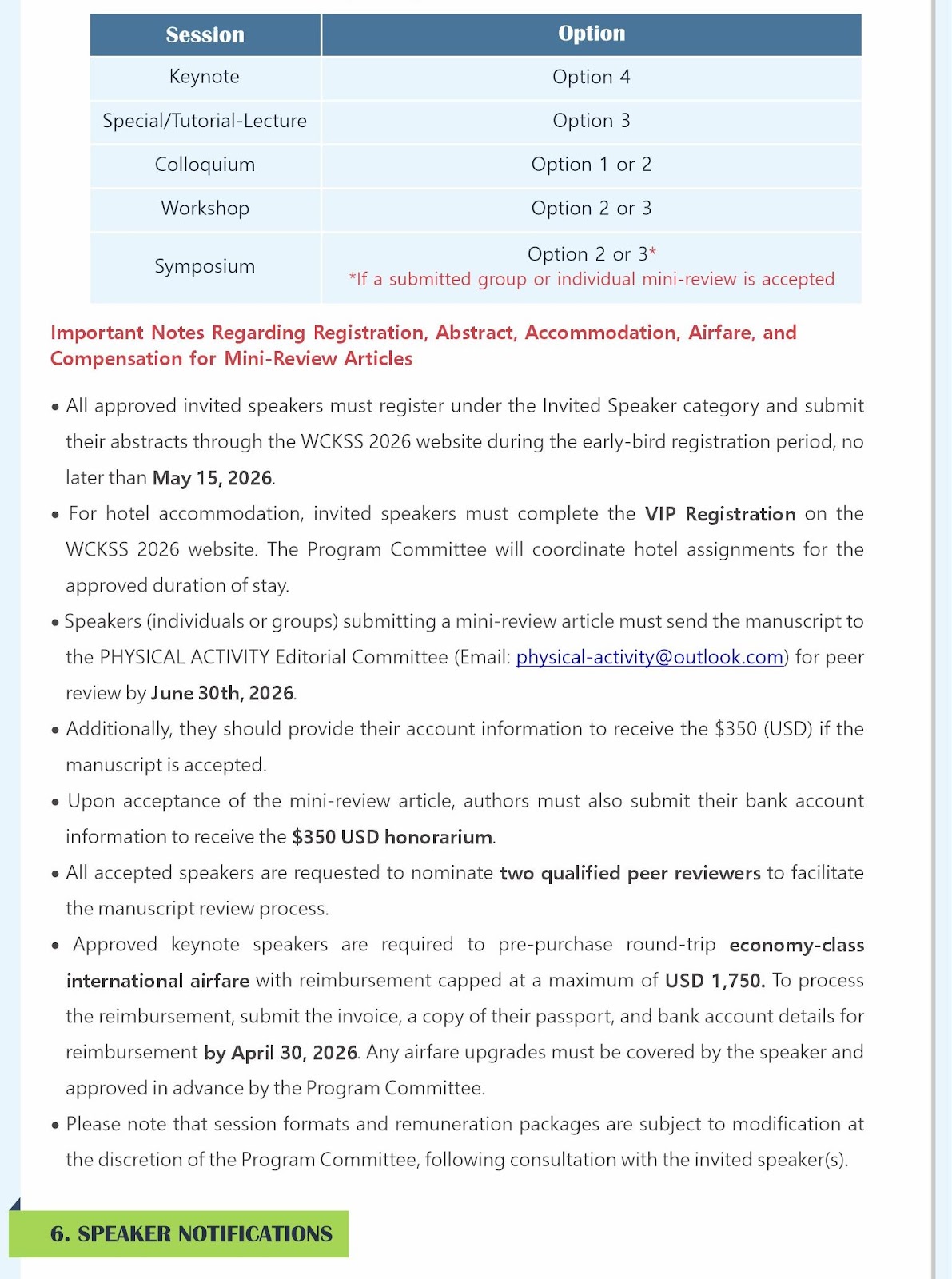
WCKSS 2026 offers four compensation packages for accepted session proposals and confirmed invited speakers. Compensation is determined by session type, speaker responsibilities, and region of residence (for airfare eligibility). Details are summarized in Table 1. Please note that only hotel accommodation is provided.
Mini-Review Article Requirement and Honorarium
• Keynote and Tutorial Lecture speakers are required to submit a mini-review article by June 30, 2026. Upon acceptance, an additional USD $350 honorarium will be awarded.
• Symposium speakers (individual or group submissions) are also eligible to receive an additional USD $350 honorarium upon submission and acceptance of a mini-review article by June 30, 2026.
Compensation Package Options
• Option 1: Registration fee waiver
• Option 2: Registration fee waiver plus 3 nights / 4 days of hotel accommodation during the conference
• Option 3: Registration fee waiver, 3 nights / 4 days of hotel accommodation, and an additional USD $350 upon acceptance of a mini-review article
• Option 4: Coverage of economy-class international airfare (excluding domestic or intra-Indonesian flights), registration fee waiver, 3 nights / 4 days of hotel accommodation, and an additional USD $350 upon acceptance of a mini-review article
Table 1. The remuneration
for guest speakers of WCKSS 2026
|
Session |
Option |
|
Keynote |
Option 4 |
|
Special/Tutorial-Lecture |
Option 3 |
|
Colloquium |
Option 1 or 2 |
|
Workshop |
Option 2 or 3 |
|
Symposium |
Option 2 or 3*
*If a submitted group or individual mini-review is accepted |
Important Notes
Regarding Registration, Abstract, Accommodation, Airfare, and Compensation for
Mini-Review Articles
¡¤ All approved invited speakers must register under the Invited Speaker category and submit their abstracts through the WCKSS 2026 website during the early-bird registration period, no later than May 15, 2026.
¡¤ For hotel accommodation, invited speakers must complete the VIP Registration on the WCKSS 2026 website. The Program Committee will coordinate hotel assignments for the approved duration of stay.
¡¤ Speakers (individuals or groups) submitting a mini-review article must send the manuscript to the PHYSICAL ACTIVITY Editorial Committee (Email: physical-activity@outlook.com) for peer review by June
30th, 2026.
¡¤ Additionally, they should provide their account information
to receive the $350 (USD) if the manuscript is accepted.
¡¤ Upon acceptance of the mini-review article,
authors must also submit their bank account information to receive the $350
USD honorarium.
¡¤ All accepted speakers are requested to nominate two qualified peer reviewers to facilitate the manuscript review process.
• Approved keynote speakers are required to pre-purchase round-trip economy-class international airfare with reimbursement capped at a maximum of USD 1,750. To process the reimbursement, submit the invoice, a copy of their passport, and bank account details for reimbursement by April 30, 2026. Any airfare upgrades must be covered by the speaker and approved in advance by the Program Committee.
• Please note that session formats and remuneration packages are subject to modification at the discretion of the Program Committee, following consultation with the invited speaker(s).
1.6.
SPEAKER NOTIFICATIONS
Please
ensure all the speakers in your proposal are available to present if approved
to be included in the final program. Final decisions regarding program inclusion rest solely with the Program Committee.
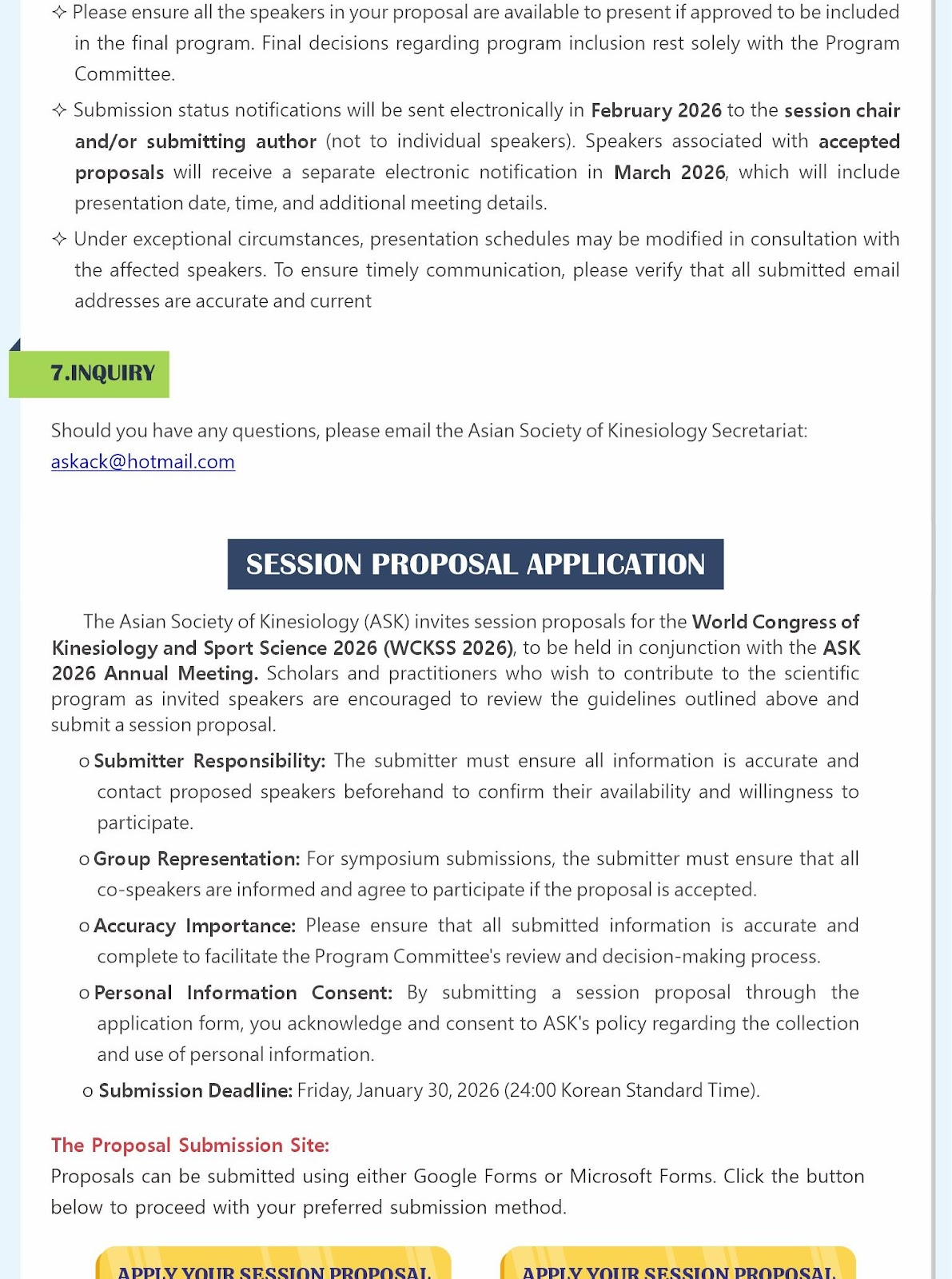
Submission status notifications will be sent electronically in February 2026 to the session chair and/or submitting author (not to individual speakers). Speakers associated with accepted proposals will receive a separate electronic notification in March 2026, which will include presentation date, time, and additional meeting details.
Under exceptional circumstances, presentation schedules may be modified in consultation with the affected speakers. To ensure timely communication, please verify that all submitted email addresses are accurate and current.
1.7.
INQUIRY